Star Trek Coda Trilogy
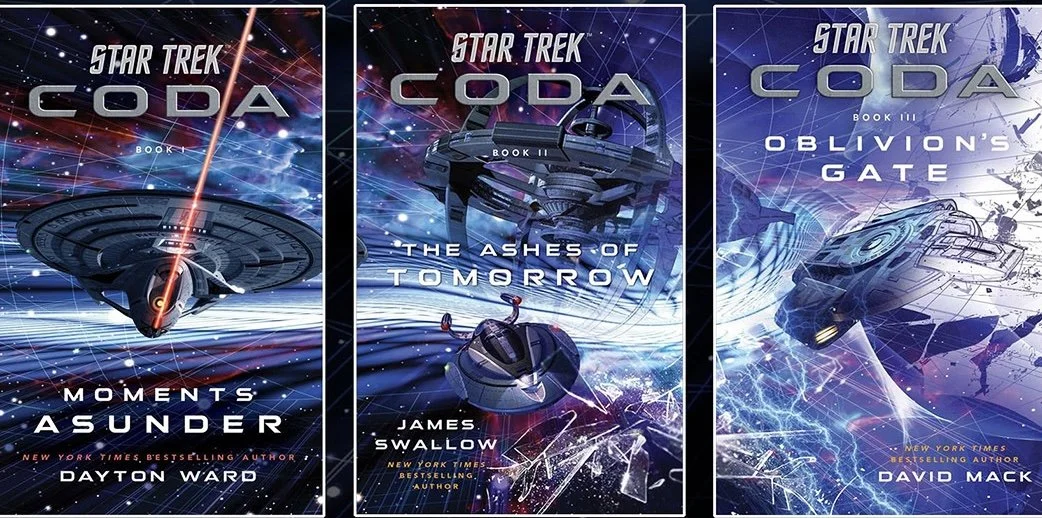
Authors: Dayton Ward, James Swallow & David Mack
Genre: Science Fiction
Rating: E — Exceeded My Expectations
Guys, it’s been a while since I’ve done a book review, and I’m sure you probably don’t remember how my book review blog used to go. So, just as a refresher, I shamelessly spoil all plots on this blog, and I’m not about to change that now.
If you don’t want to be spoiled, you might want to search the page and find where it says Bluestocking’s Learned Opinion. I won’t necessarily be going into a lot more plot there; I’ll mostly be giving you my opinion.
But if you proceed past this point without skipping?
Yeah.
That’s on you.
It would be the biggest understatement on the planet to say that everything is going awry in the Star Trek universe.
Time is literally becoming undone.
Multiple realities and timelines are being destroyed, and the destruction is causing spillover effects across any number of universes. Starfleet knows something catastrophic is happening. What they don’t know is why.
So, over the span of these three books, pretty much the entire band has to get back together.
You have Jean-Luc Picard, Beverly Crusher, Geordi La Forge, William Riker—who by this point is an admiral—Deanna Troi, Ezri Dax and the crew of the Aventine, along with quite a few other familiar faces.
And somehow all of these people have to work together long enough to figure out exactly what is happening.
That takes a little while.
If you’ve been following the Star Trek Litverse all these years, you already know that Riker’s trajectory has taken him pretty far from the affable Commander Riker we originally met on The Next Generation. I didn’t like him in this book.
Unlike what you typically see in Star Trek, the band wasn’t working well together. Although this was the problem, the bigger problem is that all of these people are limited by the fact that they exist in the here and now. Fixing the problem requires an almost omniscient perspective.
Enter Wesley Crusher.
For those of you whose Star Trek muscles are a wee bit rusty, Wesley is Beverly Crusher’s son. He left the Enterprise to study under a being known as the Traveler. Travelers are capable of moving through space, time, and even between realities in ways ordinary beings cannot.
Wesley has popped up periodically over the years, but we have never really known everything he has been doing.
Apparently, quite a lot.
Wesley realizes that something catastrophic is happening across the multiverse, and he needs help. More importantly, he needs help not only from the people in his own reality, but from their counterparts in other realities.
That is really what gets the story moving.
Concerning alternate realities. Star Trek, much like the Marvel Cinematic Universe, has the concept of a multiverse. These are not merely slightly different versions of the same reality. They are entirely separate universes that can develop in very different ways.
One of the explanations Star Trek has used for this is Schrödinger’s cat. The very simplified version is that you put a cat in a box with a mechanism that may or may not kill it. Until you open the box and observe the result, you do not know whether the cat is alive or dead. Both possibilities exist until the outcome is determined.
Star Trek takes that basic idea and runs with it. Every decision point can create another branch of reality.
So let’s say that this morning I had three shirts sitting in front of me: red, blue, and green. In one universe, I chose the red shirt. In another, I chose the blue shirt. In another, I chose the green shirt.
Most of the time, that would not make much difference. There could be three universes that are virtually identical except that Brooke wore a different shirt on September 28.
Big deal.
But sometimes a very small decision can have very large consequences.
Let’s say I chose the dark blue shirt and later walked outside on a rainy evening. A driver did not see me, hit me, and I was killed. In another universe, I wore the brighter red shirt, the driver saw me, and I went merrily about my business.
Those two universes now have a much bigger difference than my choice of clothing.
In one, I am alive. In another, I am dead.
And if, twenty years later, Alive Brooke invents something enormously important, one universe now has that invention and the other does not. From that point forward, the two realities may become increasingly different.
Multiply that by every decision made by every person over the course of history and you begin to understand the Star Trek version of the multiverse. Some parallel realities are almost indistinguishable from the Prime Timeline. Others are radically different.
Star Trek also has its famous Mirror Universe, where many familiar people exist but history and society developed very differently. That is one particular alternate reality, rather than another name for the multiverse as a whole.
So when I say Coda is about realities being destroyed, I mean entire universes—complete histories, complete civilizations, and everyone who ever lived in them—are disappearing.
I digress. Back to the plot.
Eventually, they figure out who is behind all of this.
The Devidians.
Yes. Those Devidians.
Fans of The Next Generation may remember them from “Time’s Arrow.” They are aliens that feed on the neural energy of humans.
Star Trek calls it neural energy, but I prefer to think of it as eating people’s souls.
In “Time’s Arrow,” the Devidians traveled into Earth’s past and fed on people. Why? Because before modern medicine, epidemics provided excellent cover. Would anyone really notice that a few extra people died? Nope.
Apparently, however, feeding on individual people eventually became insufficient.
The Devidians decided to go big or go home.
Now they are consuming entire universes.
And their appetite appears to be insatiable.
As everyone runs hither and yonder across time and alternate realities trying to stop them, we eventually discover something far more important.
Everything we have been reading in the Star Trek Litverse for roughly twenty years exists because of a split in the timeline.
The decision point was Star Trek: First Contact.
In First Contact, the Borg traveled back in time to prevent Zefram Cochrane from making humanity’s first contact with the Vulcans. The Enterprise followed them and stopped the Borg.
Unfortunately, all of that meddling with time had consequences.
The result was a splinter universe.
Our Litverse.
And, naturally, once you have one splinter, that splinter can create more splinters.
So this entire universe that readers have watched grow and change for years—the lives of Picard, Riker, Troi, Crusher, Sisko, Dax and everyone else—is not actually the Prime Timeline.
It is an offshoot.
Normally, that would be fine.
Unfortunately, because of what the Devidians are doing, the damage spreading through these splinter realities threatens the Prime Timeline as well.
And eventually everyone realizes the rather unpleasant truth.
The Prime Timeline cannot survive unless the splinter timeline is sacrificed.
So that is what they do.
The Litverse and the realities connected to it are destroyed.
They perish.
All of them.
And just like that, roughly twenty years of Star Trek literary history comes to an end.
Bluestocking’s Learned Opinion
Coda was a particularly apt title for this trilogy.
For those of you who are not musicians, a coda is the section of a piece of music that brings the entire work to an end.
Back when I was taking piano lessons, there would sometimes be a fairly long section of music that had to be repeated. You would play through the repeat, but instead of playing the same last few measures again, the music would direct you somewhere else.
To the coda.
And that was the ending.
So really, the clue was sitting there in the title all along. This trilogy represented an ending of some sort.
Now I’m sure some of you are thinking, Wait a minute. They destroyed the entire Litverse? What are they supposed to write about now?
Well, that was the point.
The Devidians are the villains of the story, but if we’re being honest, they are also the plot device that allowed the publishers to do something they were eventually going to have to do anyway.
End this particular version of Star Trek.
For years, Star Trek television had essentially stopped moving forward. We had The Original Series, then The Next Generation, Deep Space Nine, Voyager, and eventually Enterprise, which actually went backward in the timeline and took place before Kirk.
Once those shows ended, however, the universe continued in the books.
And I don’t mean that the authors simply filled in little gaps between television episodes.
They kept going.
People married. People had children. People died. Wars happened. Governments changed. Characters made decisions and then had to live with the consequences of those decisions.
There was a massive conflict with the Borg that eventually led to the Caeliar eliminating the Borg threat altogether.
There was the Tezwa affair and its consequences. There were the machinations of Section 31. There were political scandals. There were things that happened in one series of novels that later authors simply had to deal with because they were all writing in the same continuity.
The books developed a life of their own.
Then television came back.
Discovery was one thing because of when and where it was set.
Picard was another problem entirely.
Suddenly Jean-Luc Picard, Beverly Crusher, Will Riker, Deanna Troi, Geordi La Forge and the rest of the Next Generation characters were back on television, and the lives they had on television bore very little resemblance to the lives they had been living for years in the books.
Take Will and Deanna.
In both continuities they married, so at least everyone agreed on that much.
After that?
Not so much.
In the novels, they had a daughter named Natasha.
In Picard, they had two children, Thaddeus and Kestra. Their son Thaddeus died because the treatment that could have saved him depended upon technology that had been outlawed after the ban on synthetic life.
That is not exactly a minor continuity difference.
Then there is Beverly and Picard.
In the Litverse, they married and had a son, René.
In Picard, Beverly and Jean-Luc never married, but Beverly secretly had his son, Jack Crusher.
Again, not something you can explain away by saying somebody forgot a birthday.
These are completely different lives.
And that was the problem.
In Star Trek fandom, the television shows and movies are canon. The novels are not.
So once Paramount decided it wanted to continue telling the stories of these characters on television, nobody was going to tell the people making Picard, “Sorry, you can’t do that because a novel published twelve years ago says Riker’s daughter is named Natasha.”
The television story was always going to win.
Canon wins.
And once Picard started moving these characters in a completely different direction, the Litverse could no longer continue pretending that everybody was still living in the same universe.
One way or another, the books had to stop.
The Star Trek fandom was understandably very upset about Coda.
I knew before I started reading the trilogy that the Litverse was ending, so I wasn’t exactly blindsided by what happened.
And, quite frankly, this wasn’t my first rodeo.
Star Wars had already done this to me.
I used to read a ridiculous number of Star Wars books. My introduction to the Expanded Universe actually happened when I was in college. I was bored one day and went wandering through the college bookstore. The store was mostly, unsurprisingly, full of textbooks, but there was a small section of books one might actually want to read voluntarily.
Interestingly enough, that was also the first place I ever saw the Harry Potter books.
I didn’t buy them.
Don’t ask me why.
Anyway, I saw a Star Wars book and thought, Why not?
I think I came in somewhere around Timothy Zahn’s Thrawn books.
And that was pretty much all she wrote.
After that, I eagerly waited for every new Star Wars book. I don’t remember anymore whether they were coming out every month or every couple of months. I just remember that there always seemed to be another one coming.
And the Expanded Universe actually moved forward.
Han and Leia married and had three children: the twins Jaina and Jacen, followed by their younger son, Anakin.
And those children did not remain perpetually adorable little Force-sensitive Solo children who occasionally appeared when the plot required them.
They grew up.
People tried to kidnap them because they were so strong in the Force. They trained as Jedi. They had relationships. They made mistakes. Really big mistakes in some cases.
Then came The New Jedi Order and the Yuuzhan Vong.
That series was big. It was audacious. It was sometimes ugly.
And I loved it.
The Yuuzhan Vong were an extragalactic species that invaded the Star Wars galaxy, and the resulting war lasted through nineteen novels.
This wasn’t another variation on, Oh look, the Empire is causing trouble again.
This was something completely different.
And there were consequences.
One of Han and Leia’s children died.
Dead.
Not mostly dead.
Not caught in a temporal anomaly.
Not secretly living in another dimension waiting for somebody to discover him fifteen books later.
Dead.
And his death had devastating consequences for Han, Leia, Jacen and Jaina. If I’m being honest, I went through the 5 stages of grief too!
Governments fell. Political systems changed. Planets were devastated. People lost friends and family. By the end of that war, pretty much everybody had been through hell.
And then they had to live with it.
That’s what I liked about the Expanded Universe.
When an author did something, the next author was stuck with it.
If somebody died, he was dead.
If a government fell, somebody had to figure out what government came next.
If somebody suffered through a catastrophic war, that person did not magically recover by the first chapter of the next book and trot merrily off on another adventure.
The universe accumulated history.
After The New Jedi Order came Legacy of the Force, where Jacen Solo’s experiences and choices eventually led him to the Dark Side and he became Darth Caedus.
Again, whether I liked every decision the authors made is almost beside the point.
Things happened.
Characters changed.
The story moved.
Eventually we got Crucible, which was essentially the last big adventure centered on Luke, Han and Leia and was intended as a passing-of-the-torch story. The message was pretty clear: these people had been saving the galaxy for decades. It was time for the next generation to start carrying more of the load.
And then Disney bought Lucasfilm.
You can probably guess what happened next.
The new movie trilogy was coming, beginning with The Force Awakens, and there were decades of books sitting there saying exactly what Luke, Han, Leia and their children had been doing.
Disney wanted to tell a different story.
So the Expanded Universe became Legends.
And we started over.
People were furious.
I wasn’t exactly thrilled myself.
I had spent years reading those books. I knew those characters. I had watched those children grow up. I’d watched them suffer through the Yuuzhan Vong war. I’d watched Jacen go from this thoughtful, philosophical kid to Darth Caedus.
And suddenly none of that was part of the new canon.
Sound familiar?
I did try some of the new Star Wars books.
As a matter of fact, I reviewed Bloodline, and I went into that book quite determined not to like it.
Unfortunately, it was good.
As I wrote at the time, How odious it is to end up liking something one is quite determined to hate.
So clearly I survived.
Which is probably why I could approach Coda with a little more equanimity than some readers.
I’d already been through a literary universe being dismantled because the people making the movies wanted their toys back.
My concern isn’t really that Star Trek reset the Litverse.
I understand why they did it.
My concern is what happens now.
Because this is where I think the Star Wars reset has been much less successful for me.
The Expanded Universe was willing to move.
The newer books I’ve read have felt much more static.
Jedi vs Empire.
Been there. Done that. Got the tee shirt to prove it.
At a certain point I found myself wanting to give the entire new Star Wars publishing line one of my old ratings:
G — Get on with the plot already.
I stopped reading Star Wars years ago. I have no plans to go back to it.
I mean, part of me gets it. If you’re actively using characters are planning to use characters in a television series, you can’t have the writers killing them off in Books, but when ends up happening, is that essentially the characters have their adventure but at the end of the book almost everything has to reset so it doesn’t conflict with the television show which is considered to be canon.
And that’s my concern for Star Trek.
I don’t mind losing the Litverse nearly as much as I mind losing the kind of storytelling the Litverse allowed.
And I’m already seeing a little bit of that with the newer Star Trek books.
Discovery got a small series of novels. Strange New Worlds has had a handful. But we aren’t getting books the way we used to.
Back in the day, there was always another Star Trek book coming.
Sometimes more than one.
Now it seems that a lot of the novels are going back to the Original Series era, exploring stories that can fit between the original five-year mission and the movies or in some other conveniently unused space in the timeline.
And to be fair, some of those books are very good.
That isn’t really my complaint.
My complaint is that there is a difference between telling another good story about characters we already know and allowing those characters—and the universe around them—to actually go somewhere.
The older Star Trek shows were certainly episodic. The Original Series was very much that way. Even The Next Generation generally wrapped up the problem of the week before the credits rolled, although it began carrying more things forward as the series progressed.
Then Deep Space Nine really started doing the big story arcs. Voyager had continuing storylines as well.
And the books took that idea and ran with it.
There was always another story coming, but more importantly, there was a sense that all of those stories were building something.
I miss that.
Of course, I can hardly complain that I have nothing left to read. Star Trek books have been published forever, and there are plenty of older ones I never got around to reading. I could probably spend years filling in those gaps.
Still, it feels as though Star Trek as a whole has some decisions to make about exactly where it wants to go.
Personally, I think there is an enormous storytelling opportunity sitting right in front of them.
Discovery eventually jumped roughly a thousand years into the future. Now Starfleet Academy is operating in that future as well.
Fine.
Then go forward.
There are centuries upon centuries between the Star Trek we already know and that future that have barely been touched.
What happened?
What changed?
What happened to the Federation along the way?
What new civilizations joined?
Which ones disappeared?
What wars happened?
What technologies changed everything?
There is an enormous amount of history sitting there waiting for somebody to write it.
Why keep squeezing another story into increasingly tiny spaces in the timelines we already know when there are hundreds of years where practically anything could happen?
And while I’m complaining—
Because apparently I’ve reached that portion of the review—
I have another issue with some of the newer Star Trek television series.
The older Star Trek shows understood that Starfleet was not simply a collection of friends who happened to be traveling through space together.
It was an organization.
A quasi-military organization, but an organization nonetheless.
There were ranks.
There was a chain of command.
There were orders.
And when people ignored orders, there were consequences.
People could have relationships. They could have problems. They could fall in love, get angry, grieve, argue and generally behave like human beings.
But when it was time to do the job, they did the job.
I thought The Next Generation, Deep Space Nine and Voyager generally balanced those things very well.
Some of the newer shows—Discovery in particular—leaned much further into everybody’s feelings at moments when I found myself thinking, “you’re a grown behind man/woman. Quit whining, putting your big girl/boy pants on and handle it!” Oh and another thing, what is up with giving Michael Burnham a second chance after she literally started a war because she despite her Vulcan training lacked impulse control? And the guy she ends up with, Book, same thing for him. I wouldn’t trust either as far as I could throw them. Ridiculous.
Thankfully, the novels have the good sense not to fill themselves with that nonsense.
And that may be because the people writing Star Trek books have often been writing these characters and this universe for years. They know how these people sound. They understand the structure of Starfleet. They understand that there is a difference between Picard having feelings about something and Picard forgetting that he is commanding a starship.
Frankly, I think the television writers and the novel writers occasionally need to be locked in a room together.
The book writers get it.
Or at least they often seem to get the characters and the universe in a way that some of the television writing does not.
So where does that leave us?
We had the Litverse.
We have the much smaller Kelvin Timeline collection of novels.
We have the television-canon books attached to the current series.
And now we wait to see whether Star Trek publishing eventually builds another universe with enough room to grow, or whether the novels remain stories fitted carefully into whatever spaces television leaves available.
I hope it’s the former.
As for Coda itself, I liked it.
I knew where we were going before I ever opened the first book.
The Litverse was going to die.
What mattered was how they got us there.
And I thought they did it well.
It could very easily have been hokey. It could have felt like three books whose only purpose was to sweep twenty years of inconvenient continuity into the trash before Picard came through the door.
It didn’t.
Even Riker—who, as I said earlier, was working my last nerve for portions of this trilogy—ultimately behaved exactly as I would expect a Starfleet officer to behave.
When these characters finally understood what had to be done, they did it.
They sacrificed themselves.
Not simply themselves as individuals, but their entire reality, because allowing their universe to continue meant putting the Prime Timeline and countless other realities at risk.
That is Starfleet.
And if this particular version of Picard, Riker, Crusher, Dax and everyone else had to go, that was an appropriate way for them to go.
I’ve already read—or, more accurately these days, listened to—some of the newer Star Trek books, so I’ll be reviewing those as well.
We’ll see where things go from here.
For now:
E — Exceeded My Expectations.
